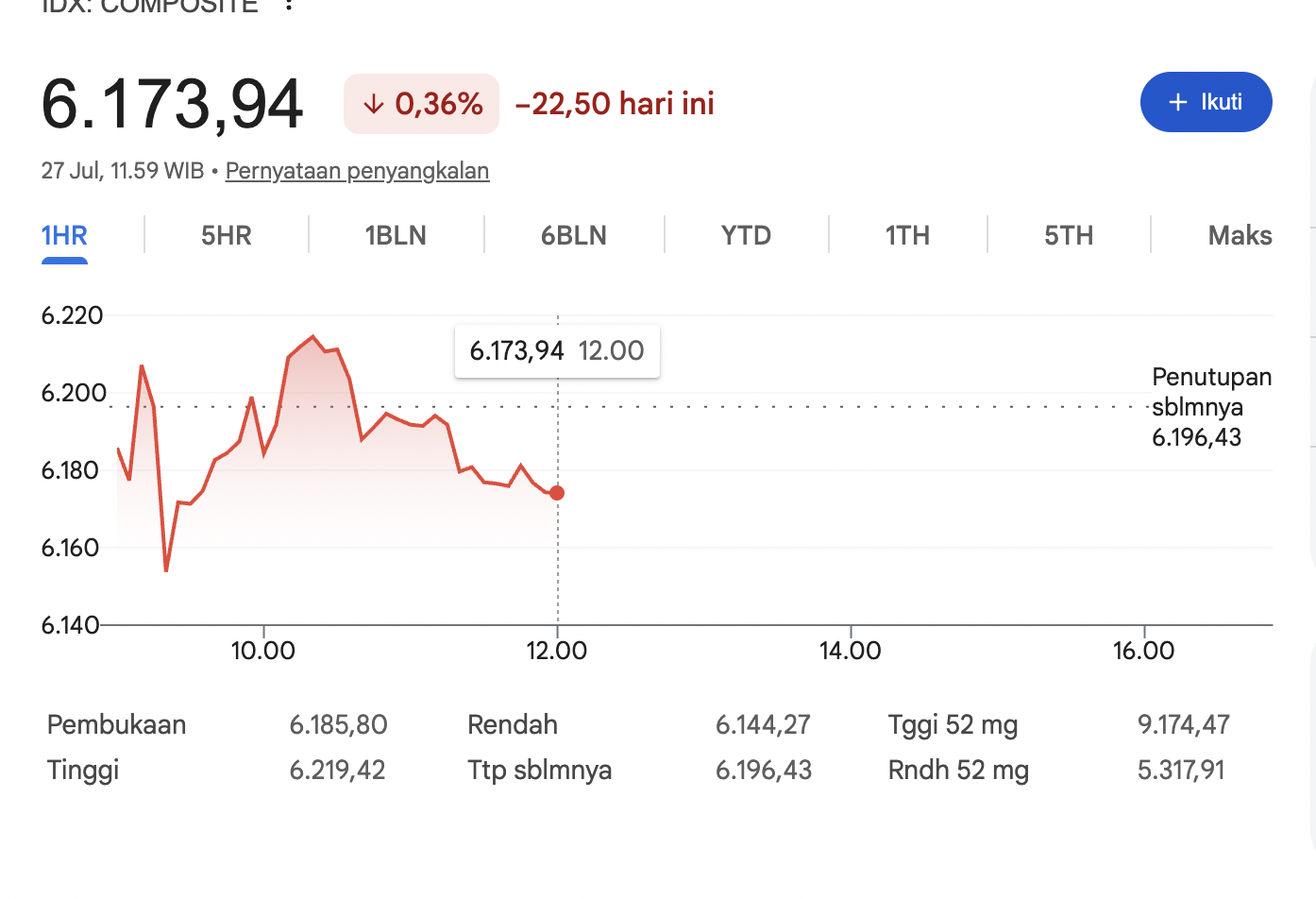
IHSG Drops 1.88% to 6,196 — 3 Factors Behind the Selloff
After nine consecutive trading days of gains between July 9 and July 21, Indonesia's benchmark stock index reversed sharply, falling 1.88% to close at 6,196.43. Every single sectoral index finished in the red, with consumer non-primary goods stocks leading the decline at over 3%. If you've been riding the recent rally, this is worth understanding clearly — not as a reason to panic, but as a reminder of exactly what kind of forces can move a market this fast.
Factor 1: Oil Prices Surging on Middle East Tensions
Renewed escalation in Middle East conflict pushed global crude oil prices sharply higher this week. Higher oil prices squeeze corporate margins across multiple sectors and typically trigger profit-taking in equity markets broadly, since investors price in higher input costs and inflation risk. Compounding the concern, analysts noted that if the conflict drags on, oil prices could stay elevated for an extended period rather than reversing quickly — a scenario markets generally price in as a sustained headwind rather than a brief shock.
Factor 2: New US Tariffs on 60 Trading Partners, Including Indonesia
Investors are also weighing the impact of new US import tariffs of roughly 10-12.5%, applied to around 60 trading partner countries, with Indonesia among them. Tariff announcements create uncertainty well beyond the directly affected exporters — they ripple into currency markets, supply chain planning, and corporate earnings forecasts, which is exactly the kind of uncertainty that tends to trigger broad, sector-wide selling rather than a narrow, contained reaction.
Factor 3: A Wall Street Selloff Tied to AI Valuation Concerns
Perhaps the most globally significant factor was a sharp selloff on Wall Street, spreading across Asian markets including Japan's Nikkei 225 (down 1.2%), South Korea's Kospi (down 1.8%), and Australia's ASX 200. The trigger: disappointing quarterly results from major US tech names. Tesla shares fell nearly 15% — its worst day since March 2025 — after second-quarter earnings missed expectations, while Alphabet dropped around 7% after raising its full-year capital expenditure projections, feeding concerns that AI-related valuations across the tech sector have become stretched relative to near-term earnings realities.
Why This Correction Is Being Called "Healthy" Despite the Size of the Drop
Market observers have generally described this pullback as a normal adjustment rather than a signal of deteriorating domestic fundamentals. As one capital markets analyst put it, a correction of more than 2% following nine straight days of gains is a reasonably typical pattern, provided it isn't accompanied by a genuine shift in Indonesia's underlying economic fundamentals. In other words: the selling reflects external sentiment and short-term volatility more than a reassessment of Indonesia's economic outlook specifically.
What Analysts Are Watching Next
Technical support levels analysts have flagged for the index range from roughly 5,950 up to 6,296, depending on which research house's model you follow, with resistance in the 6,366-6,471 range. Some analysts have specifically pointed to energy and commodity stocks as relative winners in this environment, given that rising oil prices — while bad for the broader market — directly benefit energy producers. Banking stocks with strong low-cost deposit bases (CASA) have also been flagged as relatively defensive holdings during this kind of volatility.
What This Means for Retail Investors
A sharp one-day or one-week drop after a strong rally isn't automatically a trend reversal. The index had already posted nine consecutive days of gains before this pullback — some cooling off was arguably overdue regardless of the specific trigger.External, globally-driven corrections tend to be more temporary than domestically-driven ones. None of the three factors here reflect a change in Indonesia's own economic fundamentals, which is different from a correction triggered by weak domestic data or policy missteps.Diversification across sectors matters more during volatile periods like this one, since the sectors hit hardest (consumer discretionary) weren't uniform across the whole market — energy and select banking names were relatively more resilient.Avoid making large portfolio decisions based on a single volatile week. If your investment thesis was based on Indonesia's multi-year growth story rather than short-term momentum, a week driven by oil prices and US tech earnings doesn't necessarily change that thesis.
Quick FAQ
Does this correction erase the recent nine-day rally entirely? No — even after this pullback, the index remains higher than where it stood before the rally began, so this is a partial retracement rather than a full reversal of recent gains.
Are Indonesian tariffs uniquely targeted by the US, or part of a broader policy? Part of a broader policy — the roughly 10-12.5% tariff applies to around 60 trading partner countries, not Indonesia specifically, which suggests this is a global trade policy shift rather than an Indonesia-specific action.
Should I avoid tech-adjacent sectors given the Wall Street selloff? Not necessarily avoid entirely, but it's worth understanding that the selloff was concentrated in specific US mega-cap tech names facing their own earnings and valuation concerns, which isn't automatically the same story for every tech-related holding in your own portfolio.
Conclusion
The IHSG's drop to 6,196 reflects a convergence of external pressures — Middle East-driven oil prices, new US tariffs affecting Indonesia among dozens of other countries, and a Wall Street selloff tied to AI valuation concerns — rather than a shift in Indonesia's own economic fundamentals. Corrections like this are a normal part of market cycles, especially after an extended rally, and the more useful response is usually patience and diversification rather than a reaction to a single volatile week.
Written by
Aaqil Umais ZabirFinancial education writer at Kontrol Uang
Aaqil Umais Zabir writes personal finance guides for Kontrol Uang, focusing on budgeting, transaction tracking, zakat, and practical everyday financial decisions for Indonesian readers.